
Fire Protection Systems in High-Rise Buildings: Why PRVs and Pressure Zoning Matter

Explains how pressure changes from floor to floor in high-rise fire protection systems, pressure zoning methods, the roles of the PRV and the zone control valve assembly, and key points for design and maintenance.
One of the most important issues when designing fire protection systems in high-rise buildings is that water pressure changes from floor to floor. A significant pressure difference arises between the lowest and the highest floor connected to the same vertical riser. If this difference is not managed correctly, sprinklers, valves and pipes on the lower floors are exposed to excessive pressure, while on the upper floors sufficient pressure may not be available in the event of a fire.
In this article we explain why pressure zoning is needed in fire protection systems, the roles of the pressure reducing valve (PRV) and the zone (floor) control valve assembly (ZCV), and the points to consider in design.
The Pressure Problem in High-Rise Buildings
In a static column of water, pressure changes with height: every 10 meters of height difference creates a pressure difference of about 1 bar. To deliver the required pressure to the sprinklers and hose reels on the top floor, the fire pump operates at a pressure that also covers this height difference. As a result:
- On the lower floors close to the pump, pressure can exceed the working pressure of the equipment and the values foreseen in the design.
- On the upper floors, pressure is lower because of the height.
Excessive pressure on the lower floors strains the equipment, can make sprinklers operate at a flow different from the design flow and makes the hose reel hose harder to control. That is why pressure in high-rise buildings is managed by floor or by zone; this is called pressure zoning.
How Is Pressure Zoning Done?
The building is divided into zones in which pressure stays within acceptable limits. Different methods are used depending on the building height and the design:
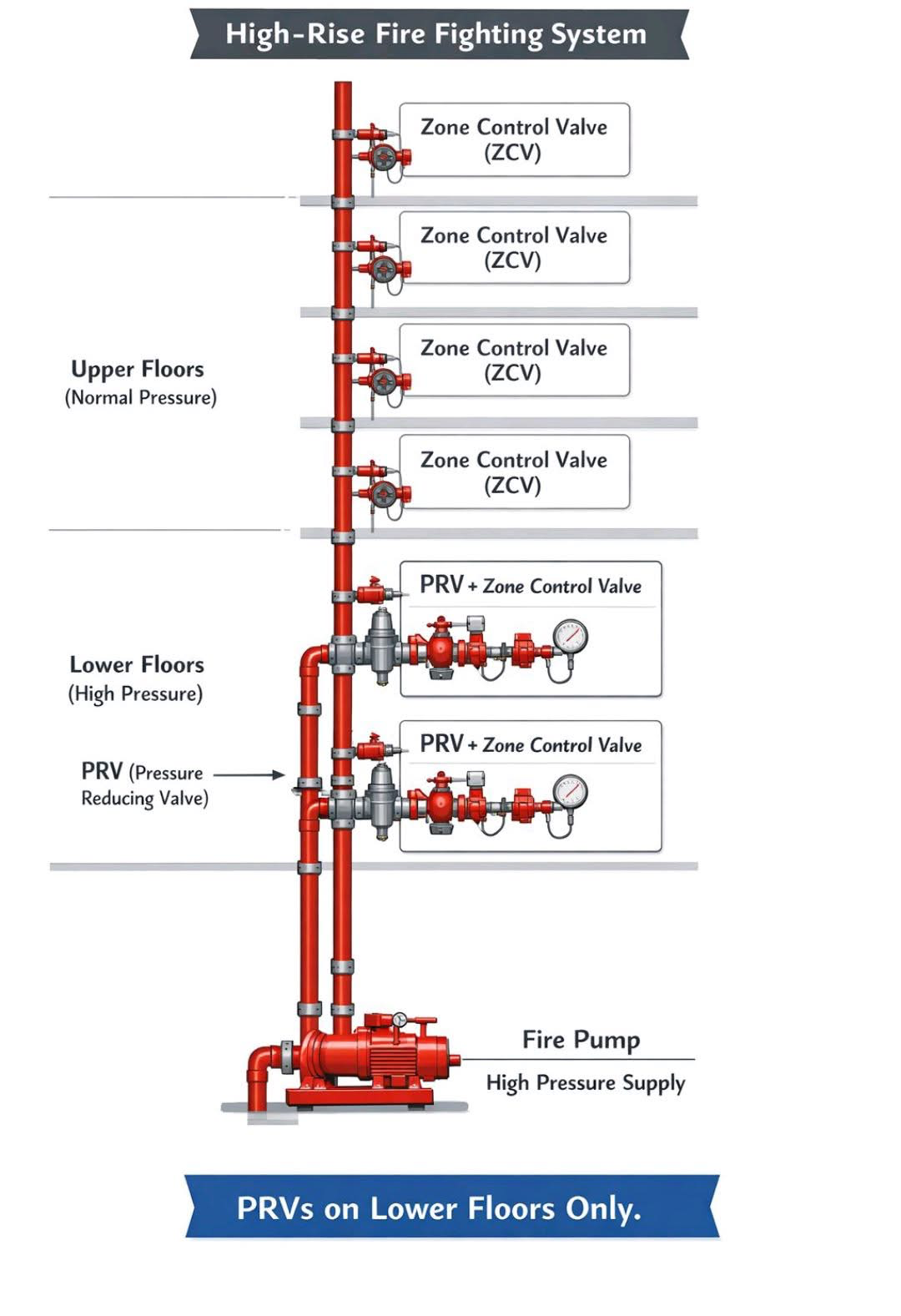
- Zoning with pressure reducing valves: A single pump set supplies the whole building; pressure reducing valves are used on the lower floors where pressure is high. The diagram above shows this method.
- Zones with separate pumps: In very tall buildings, the lower and upper zones are supplied by separate pump sets or separate risers.
- Zones with intermediate tanks: In some buildings, water tanks and pumps on intermediate floors divide the building vertically into sections.
Which method is chosen is decided in the fire protection design, taking into account the building height, water demand and the regulations in force.
System Components
Fire pump
It is usually located in the pump room at the lowest level of the building and supplies water through the main vertical riser at a pressure sufficient to serve all floors. The pump set usually includes a main pump, a standby pump and a small pressure maintenance (jockey) pump that keeps the system pressurized.
Pressure reducing valve (PRV)
A PRV (Pressure Reducing Valve) reduces the high inlet pressure to a set outlet pressure and tries to maintain this pressure while water is flowing. In fire protection systems it is applied on the floor supply line, or at hose reel and fire department connection points, on floors where pressure is high. Its functions are:
- To protect sprinklers and system equipment from pressure above their working pressure,
- To make sure the sprinklers and hose reels on the floor operate within the design pressure range,
- To prevent the loss of control that excessive pressure would cause when a hose is used.
Fire protection systems use valves that are suitable for fire service and carry the required certifications, not pressure reducers made for domestic water systems. For an example intended for fire lines, see our Y-type pressure reducing valve page.
Zone (floor) control valve assembly
The ZCV (Zone Control Valve) in the diagram is the control valve assembly at the supply point where the sprinkler system branches off to each floor or zone. It usually consists of the following parts:
- Supervised shut-off valve: Reports its open or closed position to the fire alarm panel, so a valve accidentally left closed is noticed.
- Flow switch: Raises an alarm when a sprinkler on the floor opens and water starts to flow, and shows which floor the fire is on.
- Test and drain valve: Allows the flow alarm to be tested and the floor to be drained.
- Pressure gauge: Allows the floor pressure to be monitored.
On the lower floors where pressure is high, a pressure reducing valve is added to this assembly (PRV + zone control valve); on the upper floors where pressure is already suitable, only the zone control valve assembly is used. For an example of a ready-made floor control unit, see our riser manifold page; for flow switches, supervised valves and test-and-drain valves, see our fire valves category.
Why Are PRVs Used Only Where Needed?
A PRV exists to reduce pressure only as much as necessary. Adding a PRV on upper floors where pressure is already low can further reduce the pressure reaching the sprinklers and hose reels in a fire. In addition, every PRV is an extra component whose setting can drift and which needs maintenance; using it where it is not needed increases the number of failure points. That is why the floors on which PRVs are used are determined by hydraulic calculation.
Design, Installation and Maintenance Points
- Hydraulic calculation: Zone boundaries, PRV outlet pressures and pump selection are determined by the hydraulic calculation in the fire protection design; settings must not be changed on site by guesswork.
- Regulations and standards: The design must comply with the fire protection regulations in force in your country and the standards adopted for the project (for example EN 12845 or NFPA 13 for sprinkler systems). Check your local regulations.
- Suitable equipment: PRVs, valves and sprinklers must be chosen from products suitable for fire service and carrying the required certifications.
- Installation and access: The PRV must be installed in line with the flow direction arrow on the body and placed where it can be reached for setting, testing and maintenance.
- Testing and maintenance: Whether PRVs maintain their outlet pressure correctly must be checked with a flow test at regular intervals. Test and maintenance intervals are set by the applicable regulations, standards and manufacturer’s instructions; results should be recorded.
The same pressure problem exists in the domestic water systems of high-rise buildings; there, pressure reducers suitable for domestic water are used at floor or apartment inlets. For these models, see our pressure reducing valves category.
Conclusion
Fire protection systems in high-rise buildings become safe not just through equipment selection but through a sound engineering approach. Basing pressure zoning on hydraulic calculation, placing PRVs and zone control valve assemblies on the right floors and testing them regularly help the system perform as expected in a fire. For fire protection products, see our fire protection mechanical category; for other plumbing products, see our mechanical plumbing and technical products categories.
Frequently Asked Questions
What is a PRV in a fire protection system?
A PRV (Pressure Reducing Valve) is a valve that reduces high inlet water pressure to a set outlet pressure. In high-rise buildings it is used on the lower floors, where pressure is high, to protect the equipment and make sure sprinklers and hose reels operate at the design pressure.
Why is pressure zoning necessary in fire protection systems?
Pressure in a water column changes with height; every 10 meters of difference equals about 1 bar. In a tall building supplied by a single pump, pressure rises excessively on the lower floors while it drops on the upper floors. Zoning keeps pressure within acceptable limits in each zone.
Why are PRVs not used on upper floors?
On upper floors pressure is already low because of the height. Adding a PRV there can further reduce the pressure reaching the sprinklers in a fire and creates an unnecessary failure point. The floors on which PRVs are used are determined by hydraulic calculation.
What is a zone control valve (ZCV)?
It is the control valve assembly at the supply point where the sprinkler system branches off to each floor or zone. It usually consists of a supervised shut-off valve, a flow switch, a test and drain valve and a pressure gauge; on floors where pressure is high, a pressure reducing valve is added to the assembly.
Can a domestic water pressure reducer be used in a fire protection system?
No. Fire protection systems use valves that are suitable for fire service and carry the required certifications; pressure reducers made for domestic water systems are not chosen for this purpose.
 How Are Central Heating Costs Allocated?
 What Is the 15 °C Minimum Heating Limit in Central Heating Systems?
 Underfloor Heating Systems: Costs, Price per m² and How to Choose
Talk to our specialist about product selection, installation and heat cost allocation.